Podcast
Your Support in Action
Recurring donors and foundation program officers
Nonprofit comms teams use the AutoContent API to scale their reach without scaling headcount. Annual reports become donor podcasts. Program updates become beneficiary-facing audio in local languages. Research findings become advocacy briefings for legislative outreach. One small comms team, the output of a much larger one.
The players and previews below use completed AutoContent API jobs for this industry, including the returned media URLs, hosted share pages, and quiz JSON.
Recurring donors and foundation program officers
If your nonprofit team feels like a tiny megaphone for a huge mission, this explainer is for you. Learn a simple, repeatable workflow that turns one core source document into a full multichannel campaign, without adding staff or learning technical details. Real world, actionable, and designed for communications directors, program leads, fundraisers, and executive directors who want immediate wins. What you will see in this video, step by step: - The friction every small comms team faces and how to fix it. - The three-step workflow: source document in, an auto content engine processes it as a black box, a ready-to-publish asset pack comes out. No tech degree required. - A full case study transforming a single annual impact report into a podcast with chapters, a donor-ready explainer v...
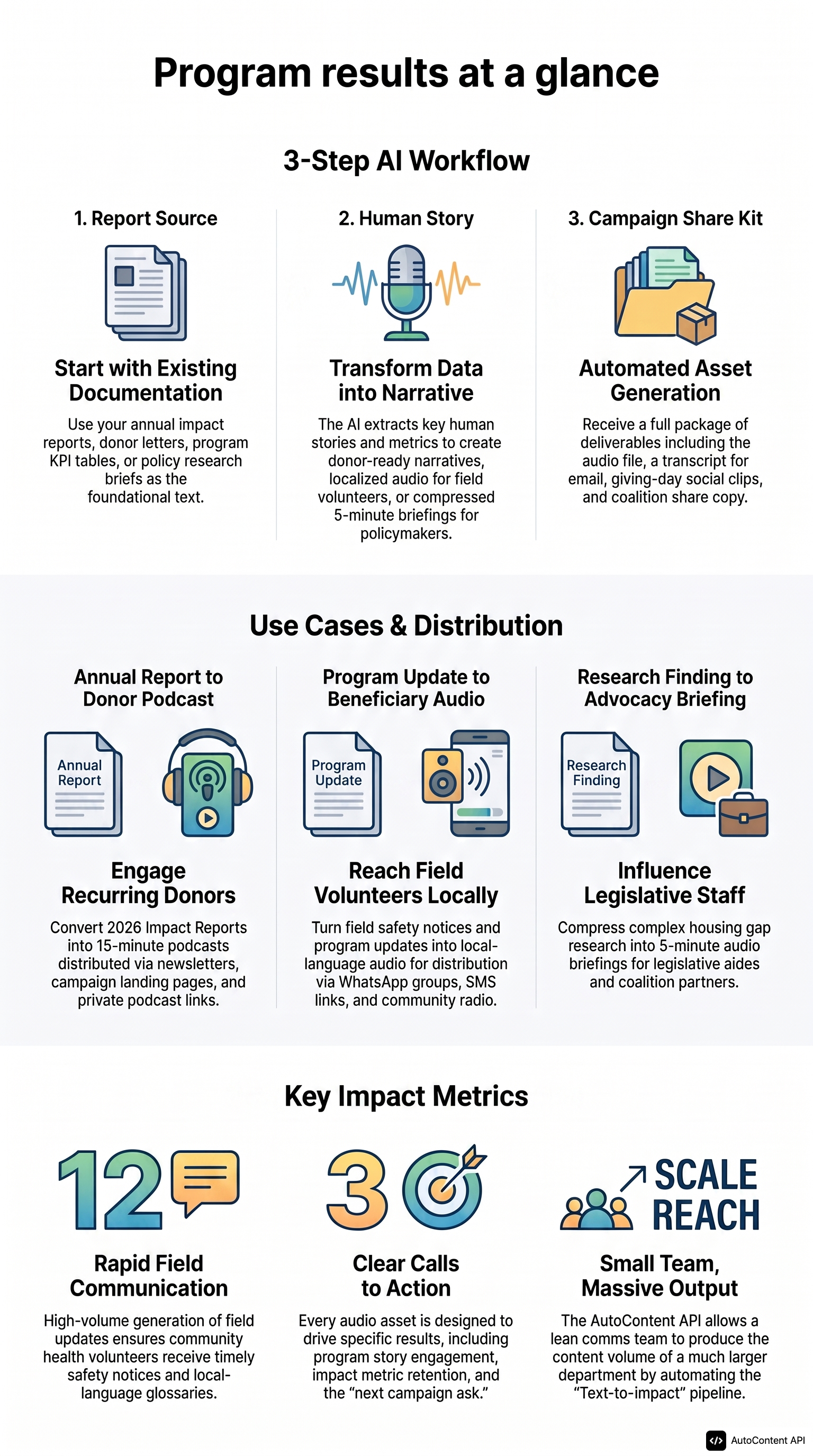
These are the kinds of outputs the API can generate from existing source material, with the audience, deliverables, and publishing path made explicit.
Annual impact report, donor letter, and program KPI table
The narrator turns outcome metrics into a human story, names the funded program, and closes each section with the specific result donors helped create.
Field program update, safety notices, and local-language glossary
The update explains clinic hours, supply pickup, and weather contingency plans in language suitable for mobile playback in the field.
Policy research brief and advocacy campaign messaging
The generated hosts open with the headline statistic, explain the affected population, and end with the campaign ask without burying it in report language.
The workflow is designed for teams that already have source material and need publishable audio or multi-format content without rebuilding their process.
Send the API the nonprofits documents, URLs, transcripts, tables, or feeds your team already uses.
Create audio, transcripts, slides, infographics, or short-form scripts from the same approved source.
Use the transcript and source-preserving structure for compliance, editorial, academic, or subject-matter review.
Route finished files into portals, LMSs, CRMs, newsletters, podcast feeds, or campaign systems.
Convert the annual impact report into a 15-minute podcast for the donor newsletter and giving-day campaigns.
Generate program updates in local languages for distribution to beneficiaries via WhatsApp, SMS audio, or community radio.
Compress research findings into 5-minute audio briefings for legislative aides and policy stakeholders.
Turn grant reports into audio summaries program officers can listen to before foundation calls.
Yes — registered nonprofits get discounted per-request rates. Contact sales with your IRS determination letter (or local equivalent) for terms.
50+ languages on input and output. Programs in Sub-Saharan Africa, Southeast Asia, and Latin America are common — generate once in English, request parallel output in the languages your beneficiaries speak.
Voice quality is high enough that donors typically do not distinguish AI-generated audio from human-narrated audio at conversational pacing. For mission-critical donor comms, use a human voice for the narrator track and the AI for the supporting cast.
Yes — tone, pacing, and voice are configurable per request. For consistent brand voice, save preset configurations and apply them across content types.
Start with one approved source and generate the audio, transcript, and supporting formats your team can review and distribute.