Podcast
How to Apply for Housing Assistance
Residents applying for public benefits
Government comms teams use the AutoContent API to make public information actually reach the public. Legislation summaries, agency updates, public-notice content, and citizen-facing program information generated as audio in dozens of languages — accessible, distributable, and produced at a fraction of human-narration cost.
The players and previews below use completed AutoContent API jobs for this industry, including the returned media URLs, hosted share pages, and quiz JSON.
Residents applying for public benefits
If your agency struggles to get dense policies into the hands of the public, this video shows a simple, nontechnical workflow that turns one source document into an entire communications campaign. Watch to see how the three-step process works in practice, from uploading a bill summary or public notice, to automatic content processing, to a full asset pack ready for every channel. You will see real-world examples for housing assistance, zoning hearings, and stakeholder briefings that prove this approach reduces friction for residents, lowers call volume for staff, and expands reach across languages and platforms. Expect audio explainers, transcripts, social shorts, infographics, slide decks, and push-ready copy that you can publish to websites, call centers, SMS alerts, or partner feeds wi...
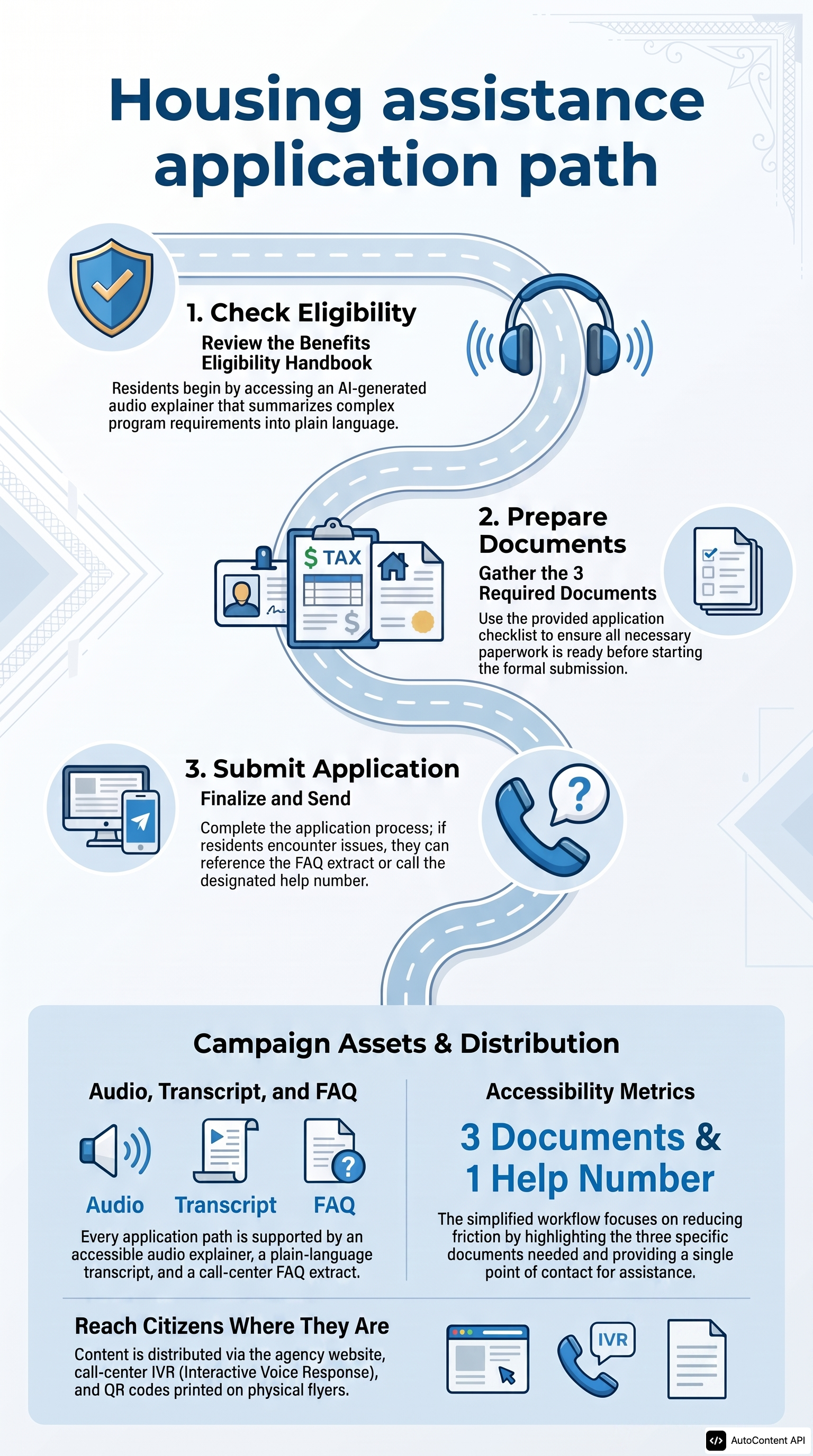
These are the kinds of outputs the API can generate from existing source material, with the audience, deliverables, and publishing path made explicit.
Benefits eligibility handbook, application checklist, and call-center FAQs
The narrator explains who qualifies, what documents to prepare, and where to ask for help, using short sentences that work for phone playback.
Public notice, meeting agenda, and translated community advisory
The generated update gives the meeting time, explains the proposed change, and repeats the public-comment deadline in plain language.
Bill summary, fiscal note, and agency implementation memo
The hosts explain the policy change, separate deadlines from interpretation, and direct listeners to the official guidance for the complete legal text.
The workflow is designed for teams that already have source material and need publishable audio or multi-format content without rebuilding their process.
Send the API the government documents, URLs, transcripts, tables, or feeds your team already uses.
Create audio, transcripts, slides, infographics, or short-form scripts from the same approved source.
Use the transcript and source-preserving structure for compliance, editorial, academic, or subject-matter review.
Route finished files into portals, LMSs, CRMs, newsletters, podcast feeds, or campaign systems.
Convert legislative summaries into accessible audio briefings for citizen distribution via agency podcast feeds.
Generate audio versions of public notices in the languages your citizen population actually speaks.
Turn agency reports into stakeholder-facing audio briefings for advocacy groups and partner orgs.
Convert program eligibility guidelines into audio explainers for citizens applying to benefits and services.
Deployment options include private API modes that satisfy most public-sector data-handling requirements. For specific compliance frameworks (FedRAMP, StateRAMP, IL4/IL5), contact sales about deployment options and ATO timelines.
50+ languages, including most common immigrant-community languages in major US/EU cities (Spanish, Mandarin, Vietnamese, Arabic, Russian, Tagalog, Korean, etc.).
Yes — federal, state, and local government entities have access to procurement-friendly pricing models. Contact sales for current terms.
Audio output is itself an accessibility win for citizens with vision impairments or low literacy. For full compliance, pair audio with transcripts (the API returns both).
Start with one approved source and generate the audio, transcript, and supporting formats your team can review and distribute.