PDF to video: a six-page guide turned into a training video
PDF to video with an API: a six-page guide on presentation slides became a narrated training video. Watch it, copy the request, and see what our check found.
How this was made. Audio and video overviews, slide decks, infographics and quizzes are made with Google's Gemini Notebook (formerly NotebookLM), on accounts that AutoContent operates. AutoContent has no agreement with Google. Google can limit or stop this access at any time.
- Length
- 8 min 12 s
- Credits used
- 50 credits
- Cost on the Starter plan
- €1.45
- Generation time
- 14 min 33 s
- Format
- Explainer video
- Job
- Training material
- Language
- English
- Generated on
- 2026-11-03
This output used 50 credits, which is €1.45 on the Starter plan (€29 per month for 1,000 credits). Failed generations use none. Generation time runs from the request to the finished file; it depends on the sources, the options and the queue.
What came out, and what we would change
We sent a six-page article from PLOS Computational Biology, "Ten simple rules for effective presentation slides", as a PDF link with type set to file, and asked for a training video that explains each rule with an example and ends with a checklist. The result is a 1280 × 720 MP4 of 8 min 12 s: an introduction, the ten rules in three groups, and the checklist.
The rules and their details come from the article: one idea and about one minute per slide (so a talk of twenty minutes has about 20 slides), a conclusion as the heading, thesis committee members as cats who chase a shiny bauble, credit on the slide where it is due, at most six elements per slide, the accessibility list (high contrast, sans serif fonts, no italics or capitals, palettes for color blindness, captions to check your pace), a slide of extra detail for questions, practice of transitions in front of peers, and a PDF copy and screenshots in case a video does not play. As asked, the author is not named.
Three statements are stronger than the article. The video states that more than six elements cause "a 500% increase" in cognitive load; the article reports this as one speaker's argument from a TEDx talk. It says surveys "show" that nobody likes slide animations, where the article says they suggest it, and it adds that animations crash presentation software. On screen, while the narration describes the article's before-and-after example, the video shows an almost empty crop of the PDF page.
PDFs with figures work as sources: the video reuses the article's own figures. The video took 14 min 33 s to generate and used 50 credits.
Transcript excerpt
Speech-to-text of the output, not edited and without speaker labels. It is part of the sample output.
Don't wait for some massive acknowledgement slide at the very end. Put proper citations right there when you make the point. For grad students, this immediately clarifies exactly what you contributed, which is super important for PhD checkpoints. And for faculty, highlighting the specific lab personnel who did the work on the relevant slide gives those folks a massive instant career boost.
Master your transitions. Focus heavily on exactly what you're going to say as you finish one slide and transition directly into the opening of the next. Like ending a slide by saying, but this led us to a brand new problem, right as you click forward. And honestly, the absolute best way to test this flow is to present to your peers. Fresh eyes will catch logic leaps you completely missed.
The exact request
The body that was sent to POST /content/Create, unchanged, and the same request as curl.
{
  "resources": [
    {
      "type": "file",
      "content": "https://journals.plos.org/ploscompbiol/article/file?id=10.1371/journal.pcbi.1009554&type=printable"
    }
  ],
  "outputType": "video",
  "format": "explainer",
  "text": "A training video for researchers and students who make presentation slides: explain each of the ten rules with an example, and end with a short checklist. Do not name the author.",
  "language": "English"
}
curl -X POST "https://api.autocontentapi.com/content/Create" \
-H "Authorization: Bearer $AUTOCONTENT_API_KEY" \
-H "Content-Type: application/json" \
-d '{"resources":[{"type":"file","content":"https://journals.plos.org/ploscompbiol/article/file?id=10.1371/journal.pcbi.1009554&type=printable"}],"outputType":"video","format":"explainer","text":"A training video for researchers and students who make presentation slides: explain each of the ten rules with an example, and end with a short checklist. Do not name the author.","language":"English"}'
# then poll until "status" is 100:
curl -H "Authorization: Bearer $AUTOCONTENT_API_KEY" "https://api.autocontentapi.com/content/Status/<request_id>"How we checked it
- Transcript
- We transcribed the output with Whisper large-v3-turbo and compared the transcript with the source.
- Language
- Detected en, requested en.
- Loudness
- -20.5 LUFS integrated, true peak -1.6 dBTP.
- Notes
- The ten rules, the slide count per talk, the element limit, the accessibility list, the slide for questions, transitions and the disaster prep match the article. Overstatements, named in the teardown: the cognitive-load figure stated as fact (its TEDx source dropped), "surveys show", and animations that crash software. Visual glitch: an almost empty crop of the PDF page.
- Checked on
- 2026-11-03. Failed generations are run again and never published.
More examples
All examples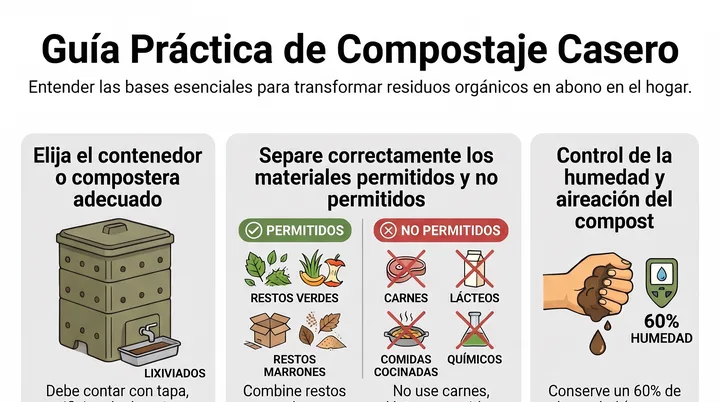 Infographic · SpanishInfografía con IA a partir de una guía: cómo hacer compost en casaOne image · 10 credits (€0.29 on Starter)
- Before the snowfall or freezing precipitation season begins, what preparation must be done to a standard manual rain gauge?A Install an automatic heating element inside the inner measuring tube.B Cover the outer cylinder with a white wooden board to keep debris out.C Fill the inner measuring tube with warm water to prevent freezing.Quiz · EnglishPDF to quiz generator: a weather service guide as fourteen check questions14 questions · 10 credits (€0.29 on Starter)
- When preparing before leaving home, what tide condition should surveyors plan to arrive during?A Any time of day regardless of tide levelB A high or incoming tideC Peak slack high tideQuiz · EnglishA training test from a PDF guide: an easy quiz for beach survey volunteers6 questions · 10 credits (€0.29 on Starter)