Podcast
CRISPR Ethics: Before Seminar
Undergraduate biology students
Education teams use the AutoContent API to turn course material — lecture notes, readings, syllabi, research papers — into audio that students actually finish. Two-host conversational podcasts replace dense PDFs for commute-time learning, and the same source generates slide decks for revision and quizzes for retention checks. One API call, multiple study formats, every course in your catalogue.
The players and previews below use completed AutoContent API jobs for this industry, including the returned media URLs, hosted share pages, and quiz JSON.
Undergraduate biology students
If your students or parents rarely open dense PDFs, this video shows a one-action workflow to turn any syllabus, lecture note, newsletter, or research paper into a full media ecosystem that actually gets consumed. You do not need to rewrite your curriculum. Drop in the material, let the Auto Content API work in the background, and get ready-to-distribute assets that meet learners where they already spend time. The workflow is three simple steps. Input your raw course material like a PDF, let the system auto-generate the assets, then distribute them through the channels you already use. From one input you can create multiple formats at scale, so every course or weekly newsletter suddenly becomes accessible and actionable. From one PDF you can generate: - A 10-minute two-host podcast comp...
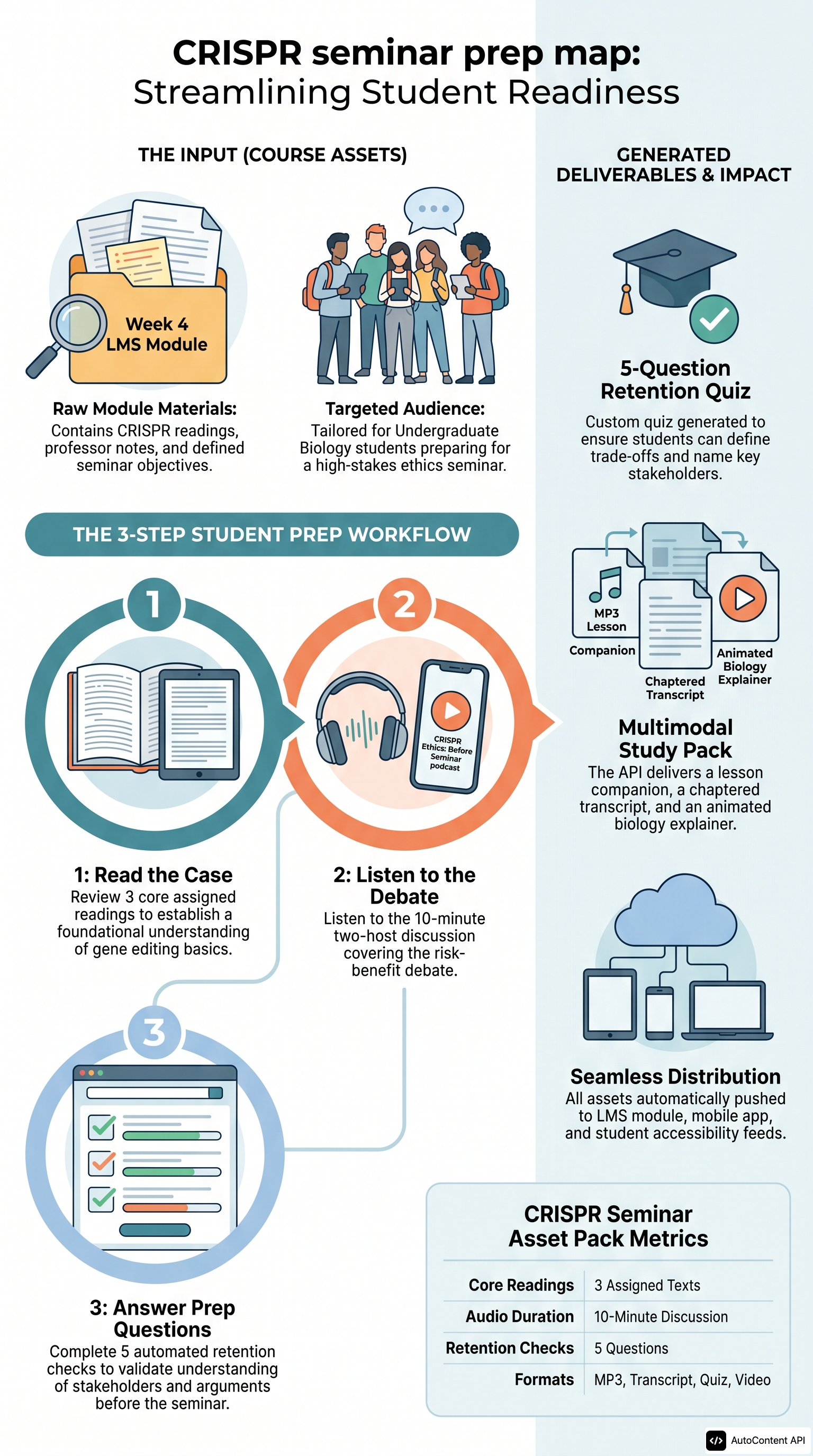
These are the kinds of outputs the API can generate from existing source material, with the audience, deliverables, and publishing path made explicit.
Week 4 LMS module with CRISPR readings, professor notes, and seminar objectives
Maya opens with the real-world decision: who gets to choose when gene editing prevents disease but changes a family line? Leo then connects that dilemma to the paper's risk-benefit framework.
Economics lecture deck, instructor notes, and midterm learning outcomes
The hosts translate nominal versus real rates into a grocery-store example, then pause for a recap slide that lists the three formulas students need for the midterm.
Parent newsletter, event calendar, and translated district notices
The generated host leads with pickup changes, explains the science-night schedule, and repeats the scholarship deadline in plain language for families listening on phones.
The workflow is designed for teams that already have source material and need publishable audio or multi-format content without rebuilding their process.
Send the API the education documents, URLs, transcripts, tables, or feeds your team already uses.
Create audio, transcripts, slides, infographics, or short-form scripts from the same approved source.
Use the transcript and source-preserving structure for compliance, editorial, academic, or subject-matter review.
Route finished files into portals, LMSs, CRMs, newsletters, podcast feeds, or campaign systems.
Generate a per-lesson podcast from each course module so students get an audio version for their commute or workout.
Convert assigned papers into a 10-minute two-host discussion that walks through the abstract, methodology, and findings.
Turn a class outline or instructor notes into a 5-minute audio brief students can listen to before class to come prepared.
Convert long PDFs into clean slide decks students can use for revision sprints during exam season.
Both. K-12 districts use it for accessibility and ELL programs; universities use it for course audio companions and research-paper discussions. The API does not assume a particular education level.
Per-request pricing scales naturally with your generation volume. For multi-school deployments and district-level licensing, contact sales for volume terms.
Yes. Many institutions wrap the API in a student-facing tool inside the LMS so students can paste a reading and get an audio version on demand.
50+ languages on input and output, including most European, Asian, and major South American languages. Useful for ELL programs, international branches, and multilingual cohorts.
Start with one approved source and generate the audio, transcript, and supporting formats your team can review and distribute.