Article to quiz: the Wikipedia article on lighthouses as a hard quiz
Article to quiz with an API: the Wikipedia article on lighthouses became a twelve-question quiz at the hard difficulty. Read it and copy the request.
How this was made. Audio and video overviews, slide decks, infographics and quizzes are made with Google's Gemini Notebook (formerly NotebookLM), on accounts that AutoContent operates. AutoContent has no agreement with Google. Google can limit or stop this access at any time.
1. John Smeaton introduced key engineering innovations when rebuilding the Eddystone Lighthouse in 1759. What structural feature of his design specifically helped to reduce the force of wave impacts against the masonry tower?
- AA gently curved inward profile modeled after the trunk of an oak tree.
- BA wide rectangular base constructed entirely of pre-assembled steel caissons.
- CA foundation of iron stanchions screwed deeply into the sandy seabed.
- DAn open lattice framework that allowed ocean waves to pass directly through the structure.
Hint: Consider how the geometric shape of the tower affects water movement when struck by waves.
Show the answer
- A · CorrectSmeaton modeled the tower's profile on an oak tree, tapering and curving it gently inward toward the top, which allowed wave energy to dissipate upon impact.
- B · Not correctSteel caisson foundations were developed later for icy or soft environments, whereas Smeaton used dovetail-jointed granite blocks on exposed rock.
- C · Not correctScrew-pile foundations were invented later by Alexander Mitchell; Smeaton anchored interlocking granite blocks onto solid rock.
- D · Not correctAn open lattice framework describes skeletal iron or screw-pile towers, whereas Smeaton constructed a solid granite masonry tower.
2. Why did Augustin-Jean Fresnel's multi-part lens design represent a major technological breakthrough over the parabolic reflector optical systems previously used in lighthouses?
- AIt allowed lighthouses to produce continuous broad lasers visible across hundreds of miles regardless of weather.
- BIt eliminated the need for burning fuel by generating light directly through a clockwork rotation system.
- CIt concentrated light into a wide vertical plane rather than a focused horizontal beam, reducing light lost to the sky.
- DIt captured and focused roughly 85% of the lamp's light while drastically reducing the required thickness and weight of large lenses.
Hint: Think about both the percentage of light captured and the physical glass volume constraints of large optics.
Show the answer
- A · Not correctLaser lights were tested much later in 1971 and proved impractical due to narrow beam widths; Fresnel lenses concentrate conventional lamp illumination.
- B · Not correctClockwork assemblies in lighthouses were used to rotate the optical assembly, not to generate light without fuel.
- C · Not correctFresnel lenses redirect vertical light rays into a horizontal plane and focus them into narrow directional beams.
- D · CorrectFresnel lenses focused 85% of light compared to only 20% captured by parabolic reflectors, and their concentric step design achieved a short focal length without the massive weight of standard solid lenses.
3. Screw-pile lighthouses were effective in shallow, sandy, or muddy seabeds, but what environmental hazard frequently necessitated replacing them with steel caisson lighthouses in cold climates?
- AMoving ice floes that could shear or disrupt the open ironwork piles.
- BDeep snow accumulations that blocked essential ventilation shafts in lower wooden rooms.
- CExtreme cold temperatures that shattered solid glass Fresnel lenses in open towers.
- DHigh salt concentrations in freezing water that rapidly dissolved cast iron framework.
Hint: Focus on how freezing ocean surface conditions affect open skeletal framework foundations in northern waters.
Show the answer
- A · CorrectOpen screw-pile structures were vulnerable to being damaged or displaced by moving ice, driving the adoption of heavy steel caissons in cold northern waters.
- B · Not correctVentilation shafts are located in the lantern room at the top of the lighthouse and are unrelated to seabed pile foundation types.
- C · Not correctFoundation selection was driven by seabed and water surface stability, not temperature effects on upper-tower glass optics.
- D · Not correctWhile corrosion affects submerged metals, physical ice disruption—not salt dissolution—was the primary cause for transitioning to caissons.
Show all 12 questions
4. How do range lights (or leading lights) assist a vessel in navigating safely through a narrow, hazardous channel at night?
- AThe navigator measures the exact time delay between synchronized light flashes from two separate coastal towers.
- BThe navigator maneuvers the vessel until the taller rear light aligns vertically with the shorter front light.
- CThe navigator tracks a single stationary light that changes color from red to green whenever the ship drifts off course.
- DThe navigator keeps the vessel centered between two lights of equal height placed on opposite banks of the channel entry.
Hint: Think about how two points of different elevations appear when viewed directly along a straight line of position.
Show the answer
- A · Not correctLight characteristics (flash patterns and timing) identify individual lighthouses rather than providing precise alignment within a narrow channel.
- B · CorrectRange lights consist of two paired lights at different heights along a line of position; when the vessel is on the correct channel course, the lights align vertically one above the other.
- C · Not correctColor-changing boundary sectors are characteristic of sector lights, whereas range lights rely on geometric vertical alignment.
- D · Not correctRange lights are positioned sequentially along the direction of travel (one front and one rear at different heights), not side-by-side on opposite banks.
5. According to the formula for distance to the horizon (D = 1.22 √H), if a lighthouse lantern room is elevated from 25 feet above water to 100 feet above water, how does its theoretical navigational range (D) change?
- AThe distance to the horizon doubles from 6.1 nautical miles to 12.2 nautical miles.
- BThe distance to the horizon remains unchanged because elevation does not alter atmospheric light refraction.
- CThe distance to the horizon quadruples from 3.05 nautical miles to 12.2 nautical miles.
- DThe distance to the horizon increases by 75 nautical miles.
Hint: Consider the mathematical effect of taking the square root when quadrupling a value inside the radical.
Show the answer
- A · CorrectEvaluating D = 1.22 √25 yields 6.1 nautical miles, while D = 1.22 √100 yields 12.2 nautical miles, which doubles the range.
- B · Not correctIncreasing elevation directly extends the geometric distance to the horizon visible to a observer.
- C · Not correctQuadrupling the height doubles the range because the radical relationship means √100 = 2 × √25.
- D · Not correctThe formula calculates distance using the square root of height in feet, so height values do not add directly to distance in nautical miles.
6. Which of the following were key technological innovations introduced by Gustaf Dalén in his lighthouse illumination systems?
More than one answer is correct.
- AA sun valve that automatically extinguished the light during daylight hours.
- BA carbon arc lamp driven continuously by a steam-driven magneto generator.
- CThe use of Agamassan substrate to safely absorb and store acetylene gas.
- DA high-power laser beam designed to project a visible orientation line into the night sky.
Hint: Identify innovations focused on safe fuel storage and automated day-night operation.
Show the answer
- A · CorrectDalén invented the sun valve to automatically shut off gas flow at dawn and open it at nightfall, dramatically reducing fuel waste.
- B · Not correctCarbon arc lamps powered by steam magnetos were used in early electric light experiments, such as at South Foreland, not in Dalén's gas systems.
- C · CorrectDalén utilized Agamassan, a porous substrate, to enable the safe storage and transport of volatile acetylene gas.
- D · Not correctLaser light experiments were conducted decades later in the 1970s and were unrelated to Dalén's early 20th-century gas technology.
7. Why was the experimental high-power laser light installed at Point Danger Lighthouse in 1971 removed and replaced with a conventional light source after four years of operation?
- AThe laser beam was too narrow to be easily seen by mariners at sea.
- BThe laser light consumed too much fuel in its denatured alcohol vaporizer.
- CThe laser system required keepers to manually rewind clockwork weight drivers every hour.
- DThe intense heat from the laser cracked the surrounding Fresnel glass optics.
Hint: Think about the practical visual coverage required for a wide ocean navigation beacon.
Show the answer
- A · CorrectPractical testing demonstrated that the concentrated laser beam was too narrow for mariners to reliably pick up visually while navigating.
- B · Not correctDenatured alcohol vaporizers were components of vaporized oil lamps (like Chance Brothers installations), not laser systems.
- C · Not correctManual clockwork winding was required for 19th-century mechanical lens rotators, not modern 1970s laser systems.
- D · Not correctLens damage from heat was not the reason for removal; the key operational flaw was the narrow beam width.
8. How are Fresnel lighthouse lenses categorized by 'order,' and where are first-order lenses typically deployed?
- ALenses are ranked by the total number of glass prisms (first-order having the fewest), and first-order lenses are used in tight harbor entries.
- BLenses are ranked by focal length (first-order having the longest focal length), and first-order lenses are used in major coastal lighthouses.
- CLenses are ranked by fuel consumption rate (sixth-order consuming the most), and sixth-order lenses are placed on offshore wave-washed rocks.
- DLenses are ranked by rotational velocity (first-order spinning fastest), and first-order lenses are used exclusively on lightships.
Hint: Focus on physical optic size, focal length ranking, and the visibility range needed for open ocean coastlines versus sheltered harbors.
Show the answer
- A · Not correctFirst-order lenses are the largest and most complex optics, while harbor entries use smaller, lower-power optics (fourth through sixth order).
- B · CorrectFresnel lens orders are defined by focal length, with first-order being the largest and most powerful optic, suitable for long-range coastal landfalls.
- C · Not correctSixth-order lenses are the smallest and least powerful optics, whereas offshore wave-washed lighthouses utilize larger, higher-order lenses.
- D · Not correctLens order measures physical focal length and optical power, not rotation speed or vessel-specific placement.
9. In what ways did Aimé Argand's lamp, invented in 1782, improve upon open wood or coal fires for lighthouse illumination?
More than one answer is correct.
- AIt used solar-charged storage batteries to operate without consuming liquid fuel.
- BIt produced a steady, smokeless flame using a hollow wick.
- CIt incorporated a gravity feed system to supply liquid fuel continuously from an elevated reservoir.
- DIt emitted automated radio transponder signals directly to shipboard radar units.
Hint: Identify features related to combustion quality and liquid fuel delivery mechanisms.
Show the answer
- A · Not correctSolar panels and rechargeable batteries are features of 20th-century modern lighthouses, whereas Argand lamps relied on liquid oil.
- B · CorrectThe hollow wick supplied air to the center of the flame, ensuring complete combustion that produced a bright, steady, and smokeless light.
- C · CorrectFuel (such as whale or colza oil) was supplied to the burner via gravity feed from a reservoir mounted above it, maintaining a consistent burn.
- D · Not correctRadar beacons (racons) are electronic devices added in the modern era, whereas Argand lamps were strictly optical oil burners.
10. Why might a modern lighthouse along the Pacific coast of North America be constructed on a lower shelf below a cliff top rather than at the peak of the cliff?
- ALantern glass storm panes tend to shatter under atmospheric pressure variations at higher cliff altitudes.
- BHigh cliff elevations are frequently obscured by low-hanging clouds and sea fog.
- CLower positions allow the light beam to bounce off the sea surface, doubling its visual range.
- DBuilding on high cliffs prevents range lights from aligning with true magnetic north.
Hint: Consider how weather and atmospheric conditions at high coastal elevations impact sea-level visibility.
Show the answer
- A · Not correctAtmospheric pressure differences across coastal cliff elevations are negligible and do not damage structural storm panes.
- B · CorrectAlong coasts with frequent low fog and cloud cover, high cliff tops are often shrouded, making lower placements necessary so the light remains visible at water level.
- C · Not correctLighthouses do not rely on water surface reflection; elevated height extends horizon distance, provided fog does not obscure the beam.
- D · Not correctLighthouse positioning is determined by geographic visibility and local channels, not magnetic pole alignment.
11. Based on standard light station architectural components, which functions were carried out in the watch room (or service room) located directly beneath the lantern room?
More than one answer is correct.
- ADriving and securing iron screw piles into the muddy seabed.
- BHousing nuclear radioisotope thermoelectric generators (RTGs) in cold climate stations.
- CHousing the clockwork mechanism that turned the rotating lens assembly.
- DStoring fuel supplies and preparing lamps for nightly operation.
Hint: Think about the routine daily duties a keeper performed near the top of the tower directly under the optics.
Show the answer
- A · Not correctScrew piles are foundational elements submerged at sea level, not equipment located in upper tower service rooms.
- B · Not correctRTGs were standalone automated power units used in unmanned Soviet installations, not components of traditional keeper watch rooms.
- C · CorrectThe mechanical clockworks driven by falling weights, which turned the heavy upper optical array, were situated in the watch room.
- D · CorrectThe watch room served as the operational preparation area where keepers trimmed wicks, cleaned lamps, and stored fuel.
12. How did the vaporized oil burner (invented by Arthur Kitson and refined by David Hood) drastically increase light output compared to traditional liquid oil lamps?
- AIt vaporized fuel under high pressure and burned it to heat an incandescent mantle.
- BIt concentrated ambient sunlight collected during daylight hours through a sun valve reflector.
- CIt created a continuous electric arc between carbon electrodes using a steam-driven magneto.
- DIt harnessed radioactive decay from nuclear isotopes inside a sealed glass bulb.
Hint: Think about how liquid fuel was converted into a gas-like state under pressure to heat a mantle.
Show the answer
- A · CorrectBy forcing kerosene under pressure into a vaporizer and burning the gas against an incandescent mantle ('white sock'), luminosity was increased to over six times that of traditional oil lamps.
- B · Not correctDalén's sun valve was a control mechanism that shut off gas flow in daylight; it did not store or reflect solar energy.
- C · Not correctCarbon arc lamps powered by steam magnetos were early electric lights, distinct from petroleum vapour mantle burners.
- D · Not correctRadioisotope generators supplied electric power to automated remote lighthouses in the Soviet era; they were not fuel vaporizers.
- Questions
- 12 questions
- Credits used
- 10 credits
- Cost on the Starter plan
- €0.29
- Generation time
- 2 min 26 s
- Format
- Quiz
- Job
- Web articles
- Language
- English
- Generated on
- 2026-11-04
This output used 10 credits, which is €0.29 on the Starter plan (€29 per month for 1,000 credits). Failed generations use none. Generation time runs from the request to the finished file; it depends on the sources, the options and the queue.
What came out, and what we would change
We sent the link to the Wikipedia article "Lighthouse" (CC BY-SA 4.0) with quizDifficulty at hard, and asked for questions that check how lighthouses work and how their design changed, not only names and dates. The quiz has twelve questions on tower construction, lenses and light sources, and navigation. Three of them have more than one correct answer.
Hard here means questions that need a step of reasoning: one asks for the range of a light from the formula in the article, and another asks why the rear light of a range pair is taller. All twelve marked answers match the article.
Some explanations add facts that the article does not give: alcohol vaporizers by Chance Brothers in question 7, kerosene and a "white sock" mantle in question 12, and the air flow of a hollow wick in question 9. Question 7 calls the Point Danger laser high-power, but the article gives no power. One explanation in question 8 calls the large first-order lenses "higher-order". The questions with more than one answer do not say so; this page adds that line from the answer key.
Formulas come as LaTeX between $ signs. This page shows them as text, and the JSON keeps the LaTeX. The quiz on this page is shared under CC BY-SA 4.0, like the article. It took 2 min 26 s to generate and used 10 credits.
More outputs of this kind: AI quiz maker.
The exact request
The body that was sent to POST /content/Create, unchanged, and the same request as curl.
{
  "resources": [
    {
      "type": "website",
      "content": "https://en.wikipedia.org/wiki/Lighthouse"
    }
  ],
  "outputType": "quiz",
  "quizDifficulty": "hard",
  "text": "A hard quiz for readers of this article on lighthouses: questions that check that they understood how lighthouses work and how their design changed, not only names and dates. Use only facts that the article states.",
  "language": "English"
}
curl -X POST "https://api.autocontentapi.com/content/Create" \
-H "Authorization: Bearer $AUTOCONTENT_API_KEY" \
-H "Content-Type: application/json" \
-d '{"resources":[{"type":"website","content":"https://en.wikipedia.org/wiki/Lighthouse"}],"outputType":"quiz","quizDifficulty":"hard","text":"A hard quiz for readers of this article on lighthouses: questions that check that they understood how lighthouses work and how their design changed, not only names and dates. Use only facts that the article states.","language":"English"}'
# then poll until "status" is 100:
curl -H "Authorization: Bearer $AUTOCONTENT_API_KEY" "https://api.autocontentapi.com/content/Status/<request_id>"How we checked it
- Questions
- We checked every question, its marked answer and each explanation against the source.
- Notes
- Review notes, against the article: all twelve marked answers match it. Question 7 calls the Point Danger laser high-power, but the article gives no power. Some explanations add facts that the article does not give, for example alcohol vaporizers by Chance Brothers (question 7), kerosene and a "white sock" mantle (question 12) and the air flow of a hollow wick (question 9). One explanation in question 8 calls the large first-order lenses "higher-order".
- Checked on
- 2026-11-04. Failed generations are run again and never published.
More examples
All examples- 문화재청이 기존의 보물을 국보로 지정 예고하면서 원소재지의 정확한 표기를 위해 명칭을 변경한 사례로 올바른 것은?A 보물 제561호 '금영 측우기' → '수원감영 측우기'B 보물 제844호 '창덕궁 측우대' → '규장각 선화당 측우대'C 보물 제561호 '금영 측우기' → '공주감영 측우기'Quiz · Korean문제 만들어주는 AI로 만든 퀴즈: 보도자료로 공부하는 금영 측우기9 questions · 10 credits (€0.29 on Starter)
- 어둠 속에서 눈이 적응하는 암순응 상태 및 밤하늘 관측 조건에 대한 설명으로 가장 적절한 것은?A 도심의 인공조명은 주변 시야를 맑게 하여 밤하늘의 대기 투명도를 높여준다.B 대기 불안정과 안개가 지속되는 기상 상태가 유지되어야 밤하늘 은하수의 구조를 선명하게 식별할 수 있다.C 인공조명이 적고 공기가 맑은 지역일수록 밤하늘의 명암 대비가 뚜렷해져 더 많은 별을 인지할 수 있다.Quiz · Korean문제 만들어주는 AI로 만든 쉬운 퀴즈: 별까지의 거리와 시간5 questions · 10 credits (€0.29 on Starter)
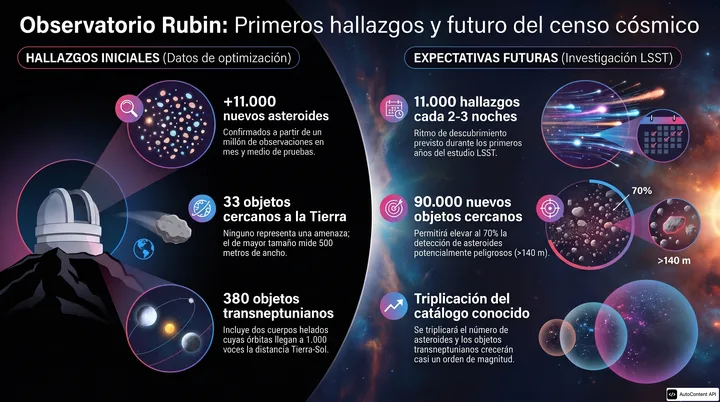 Infographic · SpanishInfografía con IA a partir de un comunicado: los primeros asteroides del Observatorio RubinOne image · 10 credits (€0.29 on Starter)